Prompt engineering is dead. Context engineering is dying. Governance engineering is next. The skill I spent two years sharpening just lost most of its value, and the reason is good news wearing a bad disguise: the models got better at the one thing prompt engineering was compensating for.
Prompt engineering was valuable because models followed instructions badly. You paid for the guesswork: tone, framing, few-shot tricks to force behavior the model would not produce on its own. That guesswork is what governance engineering replaces, and it is now the scarce skill worth building a practice around.
The skill that just lost its value
When a model ignored half your instruction, the person who could coax the right behavior out of it was worth a lot. That was the premium on prompt engineering. It was a premium on unreliability.
Frontier models follow instructions tightly now. "Edit only this file" means only that file. "Return JSON" returns JSON. The gap between what you asked and what you got has narrowed to the point where the clever phrasing barely moves the result.
So the premium moves. The scarce skill is no longer finding the words. It is designing the system in which tight instruction-following is safe and repeatable. That system is governance engineering.
Tight instruction-following is a mirror test
Tight adherence is not a victory. It is a mirror.
The model now does exactly what you specify and nothing more. No bonus modifications, no creative interpretation. Also no implicit quality, no unrequested tests, no quiet self-correction. The model used to paper over weak governance by thinking along with you. That mask is gone.
What you do not specify no longer happens on its own.
That shifts the entire burden onto the architect. Your governance system is now the only place discipline can live. If the rules are not in the architecture, they are not anywhere, because the model will not improvise them for you anymore.
What governance engineering actually is
Governance engineering is a stack, not a mindset. It has layers, and each layer answers a concrete question about an agent: what it may do, what it did, whether it is sound, how much trust it has earned, and how it stays sharp over time.
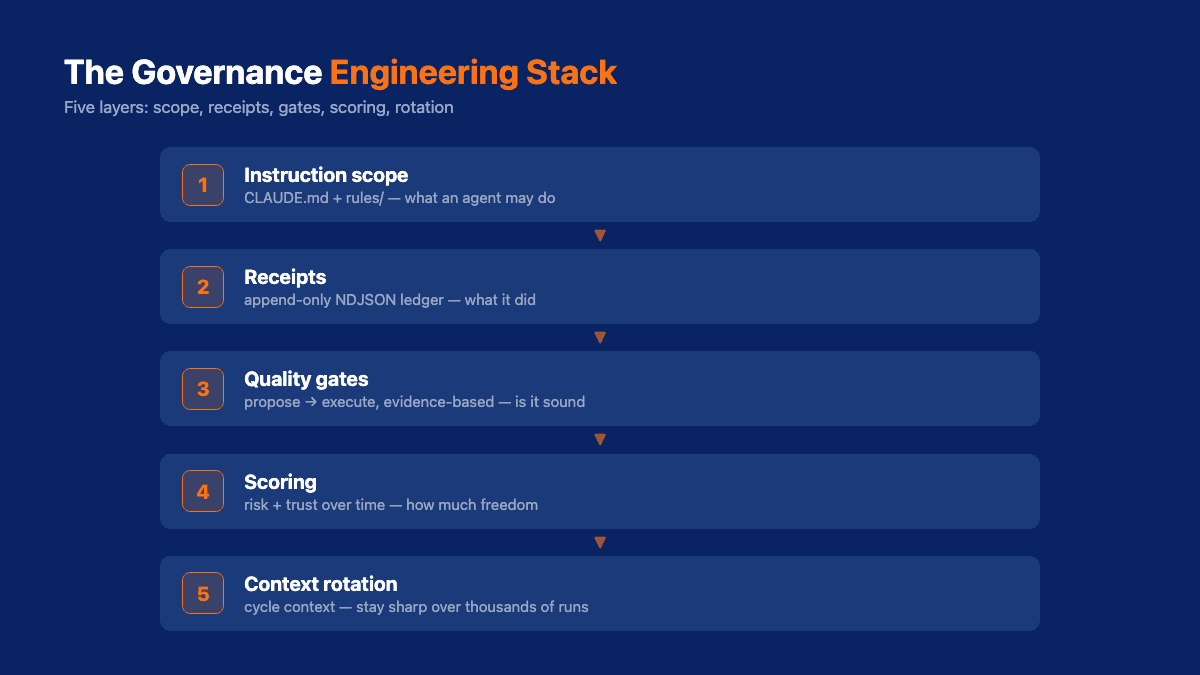
-
Instruction scope. Define exactly what an agent may touch and do. Rules in config set the playing field, and scope is the boundary inside which tight adherence is safe. Without scope, the model follows your instruction perfectly, possibly off a cliff.
-
Receipts. Every agent action writes a structured record to an append-only ledger: which agent, which commit, how long, what it cost, which model. Not chat logs that expire, a ledger that reconstructs the full history. What you do not record you cannot audit.
-
Quality gates. Between "propose" and "execute," and between "claims done" and "is done." A task closes only when the evidence is there and the checks are clear. The agent's self-assessment is an input, not a verdict.
-
Scoring. Measure whether an agent has earned more autonomy. Risk scores per dispatch, trust that accrues over time, anomaly flags that send me to the dispatches that matter. Trust is earned with data, not assumed.
-
Context rotation. Long-running agents suffer context rot as their window fills. Rotation keeps them sharp by cycling context deliberately instead of letting it grow without bound, and the governance layer makes that decay visible.
The point is the chain. Scope decides what is allowed, receipts record what happened, gates check that it is sound, scoring decides how much freedom follows, rotation keeps the system healthy across thousands of dispatches. The prompt became an input. The architecture is the control surface.
Soft law versus hard law
This is the hinge of the whole shift, and it is where most teams get governance wrong. There are two kinds of rules.
Soft law is rules in a config. A CLAUDE.md file, a rules directory, instructions a model reads and usually follows. It is policy. It works as long as the model cooperates, and with tight instruction-following, soft law is more reliable than it has ever been.
Hard law is hooks that enforce. A pre-write hook that physically stops the orchestrator from touching disk. A gate that will not close without evidence. Code, not a request.
The lesson took me a while. Soft law scales trust, hard law guarantees it. A rule you genuinely cannot allow the model to ignore must be a hook, not a sentence in a markdown file. In my own runtime the top orchestrator cannot write files directly, and that is enforced through hooks, not requested through instruction. The difference between those two is the difference between a policy and a guarantee, and I lean on deterministic quality gates for exactly the rules that must not be negotiable.
Provider independence is a governance requirement
Vendor independence is not a separate hobby. It is a governance requirement, and June made that concrete.
A governance system tied to a single provider has a single point of failure that sits outside your control. A government, a provider, or a policy change can switch off a model, and if your operation hangs on that model, your operation stops. That is not a hypothetical. On 12 June the US government forced Anthropic to disable Fable 5 and Mythos 5 worldwide, overnight, by order. I wrote about what the Fable 5 ban means for vendor-independence separately, but the governance angle is the one that matters here.
The way I design around it is plain. Workers are ordinary CLI subprocesses. There is no vendor SDK in the codebase. Receipts are provider-aware, so the ledger knows which model did what. Swapping a model is swapping a subprocess command, and the governance layer does not change. Deciding which provider runs through which lane is itself a governance decision, made explicitly, instead of trusting a default you never chose.
Governance is not overhead
The common objection is that all of this is overhead, that governance is a tax on shipping. The numbers say otherwise.
Restructuring how dispatches are constructed cut token usage by 87% while making the system more auditable, not less. The governance architecture made the work measurably cheaper to run, not just safer. That is the part the "governance equals compliance theater" crowd misses. Done as engineering, governance pays for itself.
This is the same conviction behind everything in my glass box governance work: a system you can see into is a system you can both trust and optimize.
Where the scarce skill is heading
Prompts are becoming a commodity. Governance systems are becoming the differentiator.
Whoever owns the governance data owns the intelligence. Receipts are not just an audit trail, they are the record of what worked, which makes them the raw material for the next improvement. The architect who designs the stack wins over the prompter who hunts for the perfect sentence.
Tight instruction-following handed us a mirror. What it reflects is the quality of your architecture, because the model will no longer cover for its absence. Build the stack. The sentence was never the job.
Vincent van Deth
AI Strategy & Architecture
I build production systems with AI — and I've spent the last six months figuring out what it actually takes to run them safely at scale.
My focus is AI Strategy & Architecture: designing multi-agent workflows, building governance infrastructure, and helping organisations move from AI experiments to auditable, production-grade systems. I'm the creator of VNX, an open-source governance layer for multi-agent AI that enforces human approval gates, append-only audit trails, and evidence-based task closure.
Based in the Netherlands. I write about what I build — including the failures.